
JAPANESE BIOMEDICAL EXPERIMENTATION DURING THE WORLD-WAR-II ERA
Observations from a nurse

Chapter 16 JAPANESE BIOMEDICAL EXPERIMENTATION DURING THE WORLD-WAR-II ERA
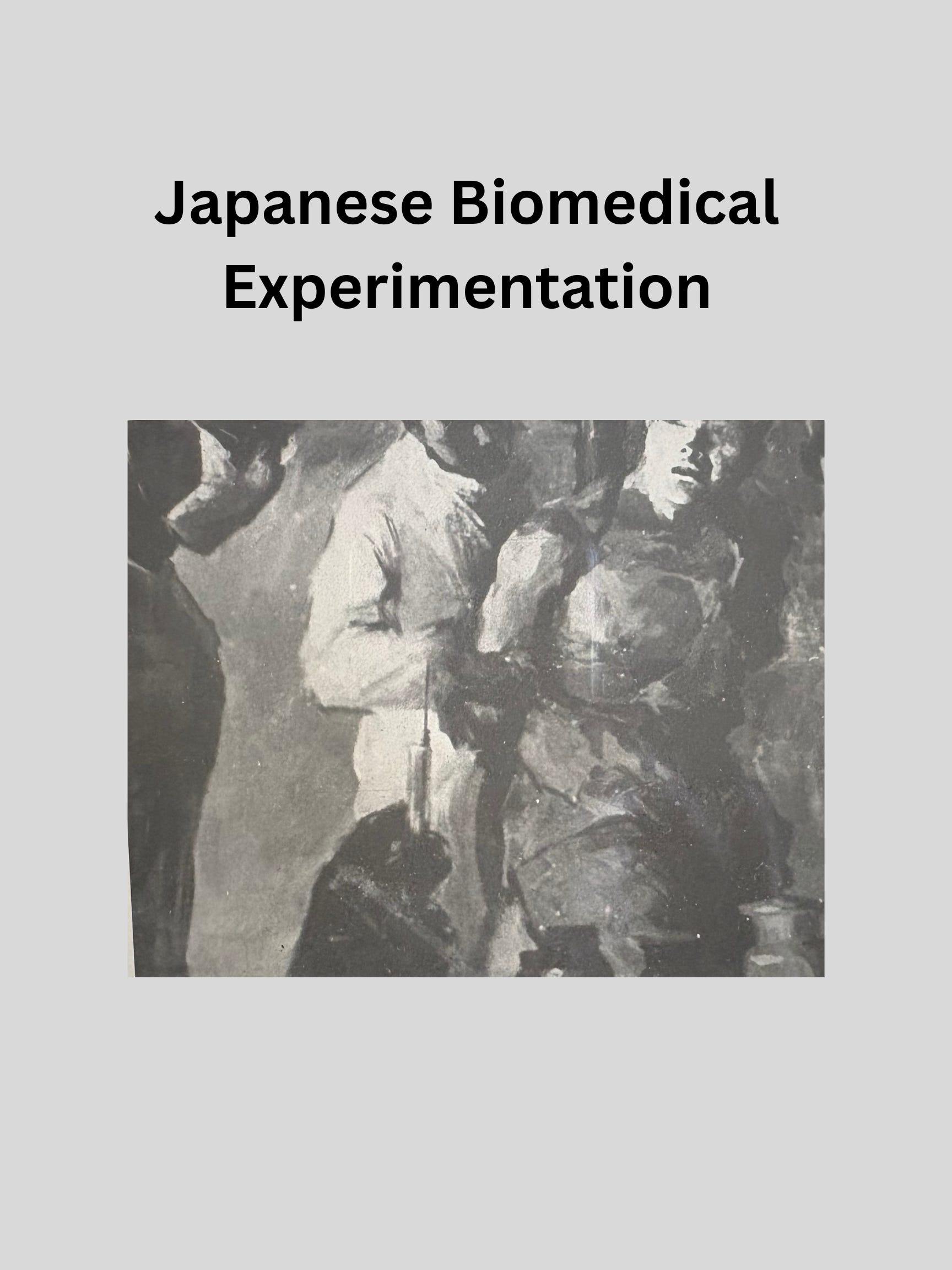
“Bacili pestis were injected into human bodies for observing the course of pathological changes.” This painting is part of an exhibit found in the Ping Fan Museum, Harbin, China. The hypodermic in the physician’s hand (forefront of the artwork) both literally and figuratively illustrates the breakdown of medical ethics in the biowarfare program in wartime Japan. Rather than using the hypodermic to treat disease, these physicians used it to initiate disease for the sole purpose of gaining information to further the use of disease as a weapon—the very antithesis of the medical profession.
Several plague tests were conducted by a number of BW units in 1940, 1941, and 1942. Exhibit 16-7 details the 1940 Ningbo pathogen test, the followon pathogen test conducted in 1941 on Chang Teh, and a comparable test in Congshan in 1942. Similar operations were conducted against cities, towns, and hamlets all over central China, and in Manchuria. Sometimes the target was attacked by airplanes. At other times, plague-infected rats were turned loose on a community. They mated with local rats, thus spreading the infectious material, and eventually causing a major plague eruption. A particularly insidious tactic was to send a team of Japanese doctors and their associates to a community. They would announce that plague had been discovered nearby, and that all residents must be inoculated against the dread disease. The people were not given an antiplague vaccine. Instead, plague germs were injected into the local citizens. This was a tactic employed by both Unit 100 and Unit 731 in Manchuria.15(pp96–99)
https://medcoeckapwstorprd01.blob.core.usgovcloudapi.net/pfw-images/borden/ethicsvol2/Ethics-ch-16.pdf
History tell the truth.
Be cautious of the treatment…
Nurse Dee
We brought the Unit 731 here: After being granted immunity, Ishii was hired by the U.S. government to lecture American officers at Fort Detrick on the uses of bioweapons and the findings made by Unit 731.
Hello Dee Dee,
Yup. 44 years living here in Japan now. It is a nice place to visit, but not a place just anyone can settle down in. Despite the horrors of Unit 731 ... or maybe because of ... Japanese people are just like any other population on earth. As a 'people', nothing exceptional as distinguished from other people ... and for moral autonomy, everything from full-blown Cluster B sociopathy to altruism of the highest order, they share the same range as any other population worldwide. Any 'studies' ranking countries by I.Q. should be taken with more than a grain of salt and tossed into the round file.
But as Edward Said pointed out, 'Orientalism' is a thing, and before that, the 'Japonaise' movement in late 19th-century European art. The 'exotic other' is an all-too-convenient mirror for projecting one's own fantasies and shadows.
As a balance for the evil indifference of those in Japan who were conveniently spared the show trials of Nuremberg, here is a small handful of courageous doctors, researchers, and journalists risking everything to fight the finely tuned Fascist ruling class of modern Japan ... https://hippocrates-movie.jp/
Though this documentary is appearing late in the game compared to what a few in the West have been trying so eloquently to point out, they were suspicious of the plandemic from the very beginning. And then outraged. The documentary was released in Japanese-only in 2025, and even then, only in small 'art' theaters.
I met the director, Hayato Ohnishi (https://www.tvu.co.jp/contact/ohnishihayato/), after one of two showings I attended, introduced myself, exchanged name cards, and through e-mail urged him to release an English version for the international market.
Even late last year, he was reluctant to do so. The Japanese ruling class has been extremely effective at framing nearly mandatory public health policies as personal choice, probably the most effective ruling class in controlling the narrative (largely through a culture of self-censurship under the cover of 'harmony'), and the long arm of the international industrial pharmaceutical complex can reach out and ruin any dissenters here in Japan just as easily as in the West. At that time, he politely declined to spread the message of Japanese dissent beyond its borders to protect his family and livelihood.
But just a couple of weeks ago, he reached out to me with a change of heart. His documentary will make its international debut in France next month, and we are busy scrambling to choose what to narrate in English and what to subtitle. For those interested in what courageous and morally autonomous Japanese professionals have to say about the plandemic, stay tuned ... and with Dr Onishi's permission, will post an update and preview of the international version here in SubStack.
Cheers from Japan.